

At a glance
If the cost of a private assessment is standing between your child and the support they need, there are more options in WA than most families realise.
This guide covers:
- A no-interest loan of up to $2,000 through Anglicare WA to help cover private assessment costs
- Two free programs launched recently in Perth, the Kaleidoscope Program (Greenhouse Paediatrics) and the Early Autism Initiative (Wild Child Paediatrics)
- Subsidised assessments through Patches, the Dyslexia-SPELD Foundation and UWA’s Robin Winkler Clinic
- The free public pathways through Child Development Services, School Psychology Service and Department of Communities
For many families, the cost of a private assessment can be a major barrier. With public waitlists often stretching beyond three years, it can feel like you’re stuck choosing between paying thousands or waiting years.
The good news is that this list keeps growing. Here is every free and low cost option I know of in WA right now, including two new free programs that launched in 2026.
| Option | Best for | Ages | Cost |
|---|---|---|---|
| NDAS (Dept of Communities) | Public autism and intellectual disability diagnosis | Autism up to 17, ID any age | Free (referral required) |
| WA No Interest Loan Scheme | Borrowing for a private assessment | Any | Free, no cost to apply |
| Kaleidoscope Program (Greenhouse Paediatrics) | Early developmental delay support | 0 to 8 years | Free |
| Early Autism Initiative (Wild Child Paediatrics) | Free autism screening and diagnosis | 18 months to 4.5 years | 3 free assessments per quarter | 12/year |
| Autism assessment scholarships (Kids are Kids) | Free autism screening and diagnosis | Children | Free via scholarship: 10 per year |
| Child Development Service | Public assessments and therapy | Children | Free (long wait) |
| Dyslexia-SPELD Association | Learning disorder assessments | Public school students | Subsidised |
| School psychology service | Screeners, observations and referrals | WA public school students | Free |
| Patches | Subsidised autism assessment | Children | Subsidised |
| Robin Winkler Clinic (UWA) | Learning disorder and intellectual disability assessments | Children and adults | $300 to $400 |
Help with paying for a private assessment
WA No Interest Loan Scheme (NILS)
What it is: no-interest loans of up to $2,000 for essential goods and services, run by Anglicare WA. This can include diagnostic assessments for your child or yourself.
Who it’s for: low income earners who can repay the loan over 12 to 24 months.
Cost: free to apply. No fees, no interest. You only repay what you borrow.
Find out more: WA No Interest Loan Scheme, Anglicare WA
Kaleidoscope Program (Greenhouse Paediatrics)
What it is: a free, sponsored program for families with young children showing signs of developmental delay. Kaleidoscope works at the very start, often with families who aren’t yet sure whether their child needs help or where to find it.
Supported by: the Stan Perron Charitable Foundation.
Who it’s for: families with children aged 0 to 8 years who may be showing signs of developmental delay. If you’re worried about how your child plays, moves, eats, socialises or communicates, this is the kind of early concern Kaleidoscope is built for.
What you get: up to 20 hours of support from occupational therapists, speech pathologists and psychologists. The team helps you make sense of your concerns, assesses your child, links you into funded and non-funded services, and builds a community of support around your child.
Kaleidoscope partners with trusted organisations including Ngala, Parenting Connection WA, Westminster Education Support Centre and Beldon Education Support Centre, so many families are referred through services they already know. Referrals from partner organisations are prioritised, but families can also submit a referral form directly and the team will get back to you.
For regional families: expressions of interest are now open for Kaleidoscope’s 2026 regional workshops in Kununurra, Collie and Katanning. The team delivers customised training for childcare centres, local organisations and families based on each community’s needs. Register your interest here.
Find out more: greenhousepaediatrics.com.au/kaleidoscope-program
Kids Are Kids! Autism Assessment Scholarships
What it is: a limited number of autism assessment scholarships for families facing long delays or financial hardship.
Who can apply: children in the Perth metro area. Regional families can apply if they can fund travel to Perth for the assessment.
Scholarship rounds open periodically, so keep an eye on the Kids Are Kids! website and social media for the next opening.
Early Autism Initiative (Wild Child Paediatrics)
What it is: a free autism screening and diagnostic pathway for up to 12 children per year, delivered pro-bono by the specialist team at Wild Child Paediatrics in Nedlands. The Early Autism Initiative (EAI) launched in May 2026.
Who it’s for: children aged 18 months to 4.5 years where autism is suspected, with priority for families who could not otherwise access a private assessment. The program accepts three families per quarter.
What the pathway can include:
- Screening using validated tools (M-CHAT-R and SRS-2)
- Developmental paediatric assessment with Dr Sabrina Barrett
- Psychology, speech pathology and hearing assessments where needed
- Formal diagnostic assessment using the ADOS-2
- A written diagnostic report with findings and recommendations
- Information sharing and observation visits with your child’s school or childcare, with your consent
- Connection to post-diagnosis supports, including National Disability Insurance Scheme (NDIS) navigation
How it works:
- Complete the online screening questionnaire. It takes about 10 minutes and can be done from home.
- The clinical team reviews your responses. If your child screens positive, you’ll be asked for a GP or paediatrician referral addressed to Wild Child Paediatrics.
- You’ll receive an intake form and consent form.
- Your child is assessed at the Nedlands clinic, with monthly appointments based on clinical need.
- You receive a written diagnostic report and connection to supports.
One thing to know. The free pathway covers screening through to diagnosis for the eligible families. If you’d like ongoing paediatric review afterwards, standard private consultation fees apply.
Find out more: Wild Child Paediatrics
Free Public Pathways
Child Development Services
What it is: the WA State Government’s free Child Development Service (CDS), which provides speech pathology, occupational therapy and developmental assessments.
You can refer your child yourself, or be referred by a GP, child health nurse or teacher.
The catch: wait times can be very long, often up to or beyond three years. My advice is to get on the waitlist anyway, even while you explore the private or subsidised options on this list. You can always come off it if something else comes through first.
Neurodevelopmental Disability Assessment Service (NDAS)
What it is: a free, state government funded diagnostic service delivered by the WA Department of Communities. NDAS assesses for autism and intellectual disability, and also determines eligibility for state-funded specialist disability services.
This one flies under the radar for many families, partly because you can’t self-refer for an autism assessment. But if your child already sees a paediatrician or child psychiatrist who suspects autism, this is a genuine free diagnostic pathway.
Autism assessments:
- For children up to and including 17 years
- Referral must come from a paediatrician or child psychiatrist, who sends their referral letter and supporting reports to the NDAS team
- A signed consent form is required before the referral can be reviewed
- Average wait is around 11 months for preschool children and around 24 months for school aged children
Intellectual disability assessments:
- Available for both children and adults where there’s a strong clinical rationale
- Referrals are preferably from a doctor or allied health professional involved in your child’s care, with developmental history and any previous assessment reports
- Average wait is around 3 to 6 months
Contact: 08 6414 1444 | assessment@communities.wa.gov.au | NDAS on wa.gov.au
School Psychology Service (WA public schools)
What it is: every WA public school has access to a school psychologist, who supports student learning through direct work with students as well as whole-school services.
This one matters if you’re worried about learning differences like dyslexia, dysgraphia or dyscalculia but a private assessment isn’t within reach right now.
What to expect: school psychologists usually don’t have capacity to complete full diagnostic assessments. What they can often do is just as valuable as a starting point:
- Complete a screener to clarify what’s going on
- Provide classroom observations, which are helpful input for any external assessment
- Determine whether a full psychological assessment is needed while school-based intervention continues
- Either conduct the assessment themselves or refer your child to specialised services (including subsidised pathways like DSF, covered below)
How to access it: put your request in writing to your school. A written request means the school can formally consider it, rather than it getting lost in a hallway conversation.
Subsidised and low cost assessments
Dyslexia-SPELD Foundation (DSF)
For families concerned about specific learning disorders such as dyslexia, dysgraphia, or dyscalculia, DSF provides subsidised assessments and therapeutic services for eligible students in WA public schools.
This is made possible through a partnership with the WA Department of Education, meaning some students can access reduced-cost or fully subsidised assessments.
How it works:
- Speak to your child’s school psychologist — they can assess your child’s needs and refer to DSF if appropriate.
- DSF also accepts direct enquiries from families.
Contact DSF:
🌐 dsf.net.au
📞 08 9217 2500
What it is: the University of Western Australia’s Robin Winkler Clinic provides neuropsychological assessments at a heavily discounted rate of $300 to $400.
They accept referrals for specific learning disorders and intellectual disabilities. They do not assess for autism, ADHD, cognitive concerns due to anxiety or depression only, or medico-legal purposes.
Wait times: the paediatric waitlist opens and closes depending on demand, with waits of around 9 to 12 months once you’re on it. Check their website for the current status.
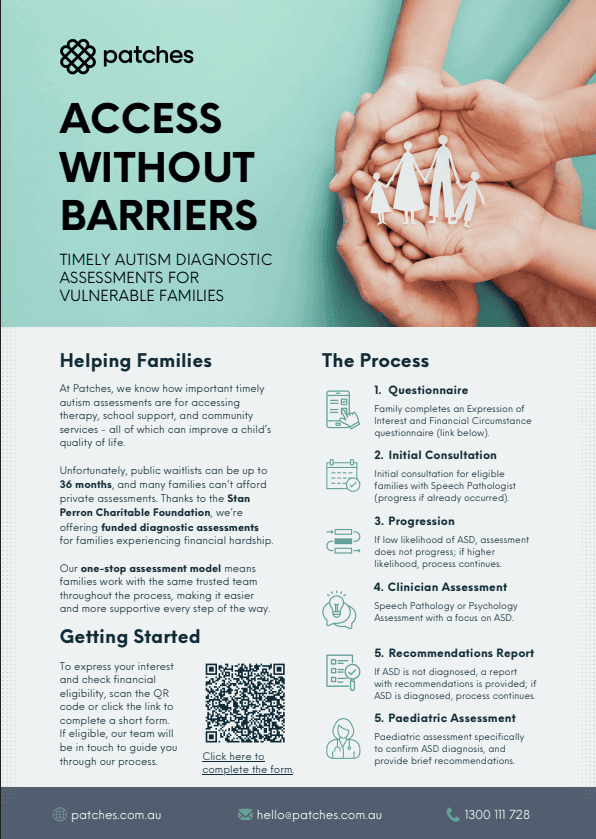
Patches subsidised autism assessments
Supported by: The Stan Perron Charitable Foundation
What it is: Subsidised autism diagnostic assessments for families experiencing financial hardship.
Patches understands how critical early diagnosis is for accessing therapy, school support, and NDIS funding. Their one-stop model means your family works with the same team (speech pathologist, psychologist, and paediatrician) throughout the process — helping make things easier and less stressful.
Eligibility: Families experiencing financial hardship.
Process:
- Complete an Expression of Interest and Financial Circumstance Questionnaire.
- Attend an initial consultation with a speech pathologist.
- If autism is likely, the assessment continues with psychology and paediatric assessments.
- Families receive feedback and recommendations for next steps.
Contact:
🌐 patches.com.au
📧 hello@patches.com.au
📞 1300 111 728
Final thoughts
Getting a diagnosis can open doors to support at school, access to the NDIS, and a clearer understanding of your child’s strengths and challenges.
If finances are standing in the way, please know that there are some options available, and more of them than even a year ago. Even if it takes time to find the right path, every step you take brings you closer to getting your child the help they deserve.
✨ Tip: Always ask clinics whether they offer payment plans or ways of easing the up-front financial cost. Some providers may offer reduced fees for families experiencing hardship.
This article is for general education only and is not a substitute for personalised medical advice.
Updated: 10 June 2026